Category Archives: SQLServerPedia Syndication

Building Resilience: Leadership Insights from Sports

In the bustling world of sports, leadership appears as a beacon of hope and direction. Imagine a football team, standing on the brink of a crucial match. The players, each with their unique strengths and weaknesses, look towards their captain for guidance. This captain, embodying the essence of leadership, understands that success is a collective effort. The leader knows that every player must feel valued and motivated to contribute their best. Through open communication and a collaborative spirit, the leader fosters a culture where teamwork thrives.

As the game progresses, challenges arise. The opposing team scores, and the morale of our team dips. Yet, the captain stays undeterred. The leader has faced setbacks before and knows the importance of resilience. With a positive outlook and unwavering determination, the leader inspires teammates to persevere. They rally together, driven by the belief that they can overcome any obstacle.

Behind the scenes, the captain’s journey is marked by discipline and commitment. The leader’s training regimen is rigorous, demanding both physical and mental fortitude. The leader adheres to a strict schedule, continuously striving to improve skills. This dedication is mirrored in the leader’s approach. The leader is committed to the vision and dedicated to the team’s growth, setting the tone for collective success.

Strategic thinking is another hallmark of the leader’s approach. On the field, the leader devises game tactics, predicting challenges and adapting strategies in real-time. This ability to think critically and make informed decisions guides the team towards their goals. Off the field, the leader analyzes situations, ensuring that every move is calculated and purposeful.

Emotional intelligence plays a crucial role in the leader’s approach. The captain experiences intense emotions, from the thrill of victory to the agony of defeat. Yet, the leader manages these emotions with grace, supporting composure and empathy. The leader understands teammates’ feelings, creating a supportive environment where everyone feels understood and valued.

Leading by example, the captain proves hard work, dedication, and sportsmanship. The leader’s actions speak louder than words, earning respect and loyalty from the team. The leader embodies the values preached, setting a powerful precedent that motivates others to follow suit.

Through the lens of sports, we see that leadership is not just about directing others; it is about inspiring them. The qualities developed through sports-minded discipline are essential for effective leadership in any domain. These qualities include teamwork, resilience, discipline, strategic thinking, emotional intelligence, and leading by example. By adopting these principles, individuals can become inspiring leaders. They drive their teams to success. This applies both on and off the field.

“Leaders aren’t born, they are made. And they are made just like anything else, through hard work. And that’s the price we’ll have to pay to achieve that goal, or any goal.” — Vince Lombardi

Unlocking Real-Time Financial Insights: The Power of Microsoft Fabric

Microsoft Fabric is transforming real-time analytics for financial institutions. It provides a unified data platform. This platform integrates various data sources into a single, cohesive system. This integration breaks down data silos. It enhances decision-making and customer insights. Fabric’s real-time intelligence capabilities allow financial institutions to extract insights from data as it flows. This enables immediate decision-making. It supports critical functions like fraud detection, risk management, and market trend analysis.

With AI embedded throughout the Fabric stack, routine tasks are automated. Valuable insights are generated quickly. This boosts productivity and keeps organizations ahead of industry trends. Additionally, Fabric ensures data quality, compliance, and security. These elements are crucial for handling sensitive financial information. They also help in adhering to regulatory requirements. The architecture is scalable to support the needs of financial institutions. They are dealing with gigabytes or petabytes of data. It integrates data from various databases and cloud platforms. This creates a coherent data ecosystem.

Real-time analytics allow financial institutions to respond swiftly to market changes, making informed decisions that drive competitive advantage. By adopting Fabric, financial institutions can unlock new data-driven capabilities that drive innovation and keep a competitive edge.

Moreover, Microsoft Fabric’s ability to deliver real-time analytics is particularly beneficial for fraud detection and prevention. Financial institutions can track transactions as they occur, identifying suspicious activities and potential fraud in real-time. This proactive approach not only protects the institution but also enhances customer trust and satisfaction. The speed of real-time analytics allows immediate addressing of potential threats, reducing the risk of financial loss and reputational damage.

Besides fraud detection, real-time analytics powered by Fabric can significantly improve risk management. Financial institutions can continuously assess and manage risks by analyzing market trends, customer behavior, and other relevant data in real-time. This dynamic risk management approach allows institutions to make informed decisions quickly, mitigating potential risks before they escalate. The ability to respond to changing market conditions is a critical advantage. Addressing emerging risks in real-time is vital in the highly volatile financial sector.

Furthermore, the integration of AI within Microsoft Fabric enhances the predictive analytics capabilities of financial institutions. By leveraging machine learning algorithms, institutions can forecast market trends, customer needs, and potential risks with greater accuracy. This foresight enables financial institutions to develop more effective strategies, improve their operations, and deliver personalized services to their customers. The predictive power of AI is significant. It, joined with real-time data processing, helps financial institutions stay ahead of the competition. They also meet the evolving demands of the market.

Microsoft Fabric’s technical architecture is designed to support complex data operations seamlessly. The integration structures like Data Engineering, Data Factory, Data Science, Real-Time Intelligence, Data Warehouse, and Databases into a cohesive stack. OneLake, Fabric’s unified data lake, centralizes data storage and simplifies data management and access. This integration eliminates the need for manual data handling, allowing financial institutions to focus on deriving insights from their data.

Fabric also leverages Azure AI Foundry for advanced AI capabilities. It utilizes machine learning efficiently. This enables financial institutions to build and deploy AI models seamlessly. This enhances their predictive analytics and decision-making processes. The AI-driven features, like Copilot support, offer intelligent suggestions and automate tasks, further boosting productivity. Additionally, Fabric’s robust data governance framework, powered by Purview, ensures compliance with regulatory standards. It centralizes data discovery and administration. It governs by automatically applying permissions and inheriting data sensitivity labels across all items in the suite. This seamless integration ensures data integrity and transparency, essential for building trust with customers and regulators.

Lastly, Fabric’s scalability is a key technical advantage. It supports on-demand resizing, managed private endpoints, and integration with ARM APIs and Terraform. This ensures that financial institutions can scale their operations efficiently. They can adapt to changing business requirements without compromising performance or security.

Long-term, Fabric will play a crucial role in the future of data analytics. It offers a unified platform that seamlessly integrates various data sources, enabling more efficient and insightful analysis. It handles large-scale data with high performance and reliability. This ability makes it indispensable for driving innovation. It also supports informed decision-making in the analytics landscape.

PASS Data Community Summit: A Personal Journey

PASSDataCommunitySummit

As someone attending the event since 2011, I would like to share my personal experience, the value of attending, and how the event has helped me throughout my career.

For decades, the PASS Data Community Summit has supported the data community, and the event itself has been going strong for more than 25 years. Looking back on my experiences, I never realized the ebb and flow the journey would take me on, but the value of attending the conference quickly became evident to me. Each year, I have gleaned new ways to improve technology, data footprints, and beyond learning from expert speakers and industry leaders.

I can still recall sitting in a session led by Chris Shaw around a DBA Maintenance database or John Sterrett’s Policy-Based Management session. The memories of those first few years were eye-opening. It quickly became evident to me that the quiet moments in between sessions were just as important (some call this the ‘Hallway Track’). Each year, I can pick out crucial conversations that happened in between sessions that left a lasting impression. You see, while this is a technology conference put on by some stellar people, it’s just that, the people and relationships built.

My journey has run the full gamut of being an attendee, volunteer, speaker, and past board member, and what I’ve found and learned through it all was that the amount of learning has been off the charts, but the people I’ve met along the way have made the journey something special.

PASS Data Community Summit brought something special that I was searching for at the time, a place where I could hone my skill set, but it became much more. I vividly remember running into an issue at work one day and being able to pick up the phone and call an expert in the field because of the friendship made at PASS Summit to get their opinion.

When you walk through the halls and see all of the people, I can remember being overwhelmed that first year, now, these years later I don’t take it for granted when I look out and see the sea of people, and I can’t help but think there are still more Chris Yates’ out there looking for something. Each year I go back and have the opportunity to speak with more folks, and I’m appreciative to have folks come up and want to talk either about a session I’ve done, spoke at, blogged about, or helped with along the way.

PASS Data Community Summit has been an incredible journey for me, both professionally and personally. The event has provided me with invaluable learning opportunities, but more importantly, it has given me the chance to build lasting relationships with some amazing people in the industry. So, on that note, I’ll see you at the PASS Data Community Summit this year and for many more to come!

What is data classification, and why is it important?

DataClassificaiton
The benefits of data classification and the features of a tool like Microsoft Purview, a unified data governance service.

Data classification organizes data into categories based on its type, sensitivity, value, and usage. Data classification helps organizations at all levels to:

  • Protect sensitive and confidential data from unauthorized access, misuse, or loss.
  • Comply with data privacy and security regulations, such as GDPR, HIPAA, or CCPA.
  • Improve data quality, accuracy, and consistency to increase reliability; enhance data analysis, reporting, and decision-making by making the data more accessible and easily understood.
  • Comply with data privacy and security regulations, such as GDPR, HIPAA, or CCPA.
  • Optimize data storage, backup, and archiving strategies.
  • Improve data quality, accuracy, and consistency.
  • Enhance data analysis, reporting, and decision-making.

Data classification is not a one-time activity but a continuous process requiring regular monitoring and updating. However, data classification can be challenging, especially for large and complex data environments. Some of the common challenges I’ve ran into in the past are:

  • Lack of visibility and control over the data sources, locations, and flows.
  • Inconsistent or missing data labels, metadata, and tags.
  • Manual and time-consuming data classification processes.
  • Difficulty in enforcing data policies and standards across the organization.
  • High costs and risks of data breaches, fines, or reputational damage.

Data classification is also essential for dealing with large volumes of sensitive and regulated data, such as customer information, transaction records, credit scores, and financial statements. Data classification can help enterprise estates to:

  • Prevent data leaks, fraud, or identity theft that can harm customers and the institution’s reputation.
  • Meet the compliance requirements of various regulators, such as the Financial Conduct Authority (FCA), the Securities and Exchange Commission (SEC), or the Federal Reserve.
  • Reduce data storage and management costs by identifying and deleting redundant, obsolete, or trivial data.
  • Improve the data quality and reliability by detecting and correcting errors, inconsistencies, or anomalies.
  • Provide relevant and accurate data to enhance data analysis and reporting capabilities, supporting business intelligence, risk management, and customer service.

How can Microsoft Purview help with data classification?

Microsoft Purview is a unified data governance service that can help organizations discover, catalog, classify, and manage their data assets across on-premises, cloud, and hybrid environments. Microsoft Purview enables organizations to:

  • Automatically scan and catalog data sources, such as SQL Server, Azure Data Lake Storage, Azure Synapse Analytics, Power BI, and more.
  • Apply built-in or custom data classifications to identify and label sensitive or business-critical data.
  • Use a data map to visualize the data lineage, relationships, and dependencies.
  • Search and browse the data catalog using natural language queries or filters.
  • Access data insights and metrics, such as data quality, freshness, popularity, and compliance status.
  • Define and enforce data policies and standards across the organization.
  • Integrate with Azure Purview Data Catalog, Azure Synapse Analytics, Azure Data Factory, and other Azure services to enable end-to-end data governance and analytics.

Data classification is a vital component of data governance and management. It helps organizations protect, optimize, and leverage their data assets. Tools like Microsoft Purview is a comprehensive data governance service that simplifies and automates data classification and other data governance tasks. With Microsoft Purview, organizations can gain more visibility, control, and value from their data.

The PASS Data Community Summit

I’m looking forward to attending the PASS Data Community Summit this year in Seattle, Washington. I’m also glad to have the opportunity to speak with fellow Microsoft MVPs Josh Higginbotham and Dr. Victoria Holt on a panel around Transformation and Innovation: Why the database must be included hosted by Steve Jones

In looking at this year’s lineup of speakers and sessions, several ones stand out to me. From a Sr. Level perspective, I’d like to tap into a few sessions:

Automate your Data Quality Validation by Aaron Nelson

Extend Azure DevOps to Take your CI/CD to the Extremes by David Bojsen

Overall, I do like how the tracks are broken out within the session catalog to give a sense of what they look like:

  • Analytics
  • Architecture
  • Database Management
  • Development
  • DE&I
  • Professional Development

It’s great to see some of my good friends, and new speakers I haven’t heard from yet regarding pre-cons. You should check them out and can do so here. Below are a few of my favorites.

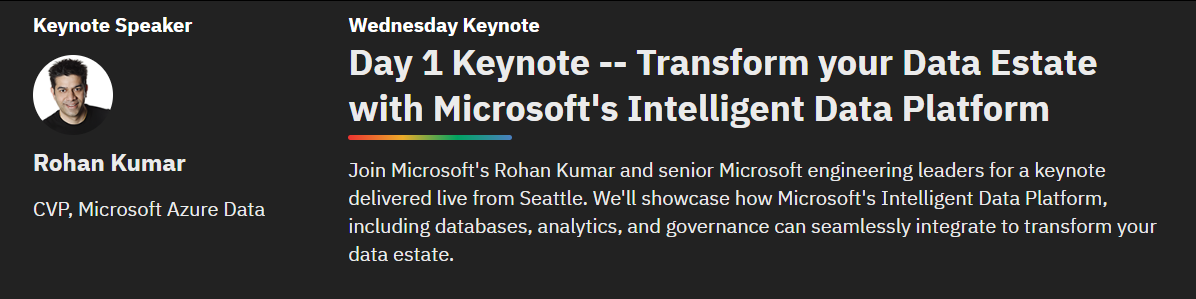
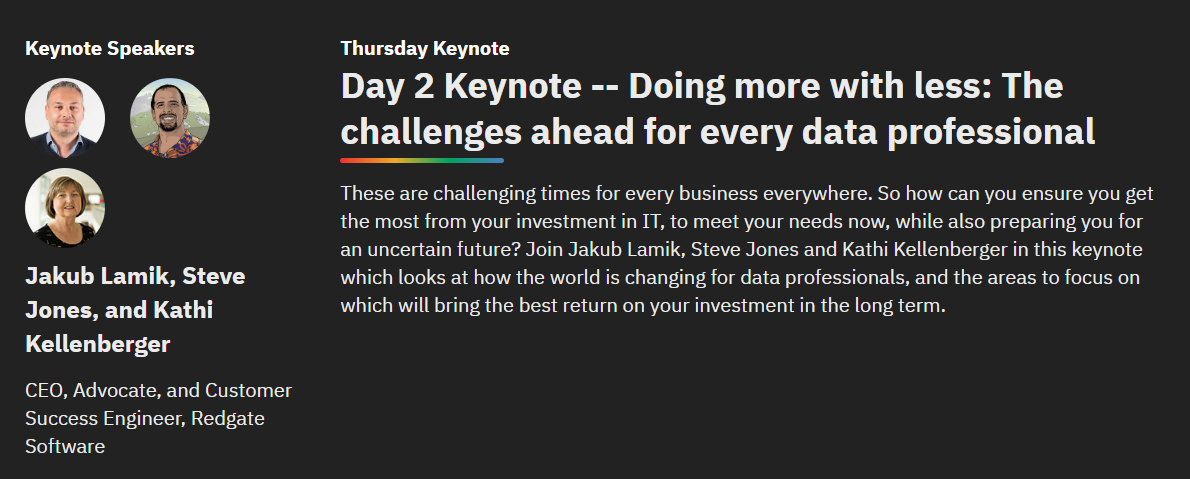
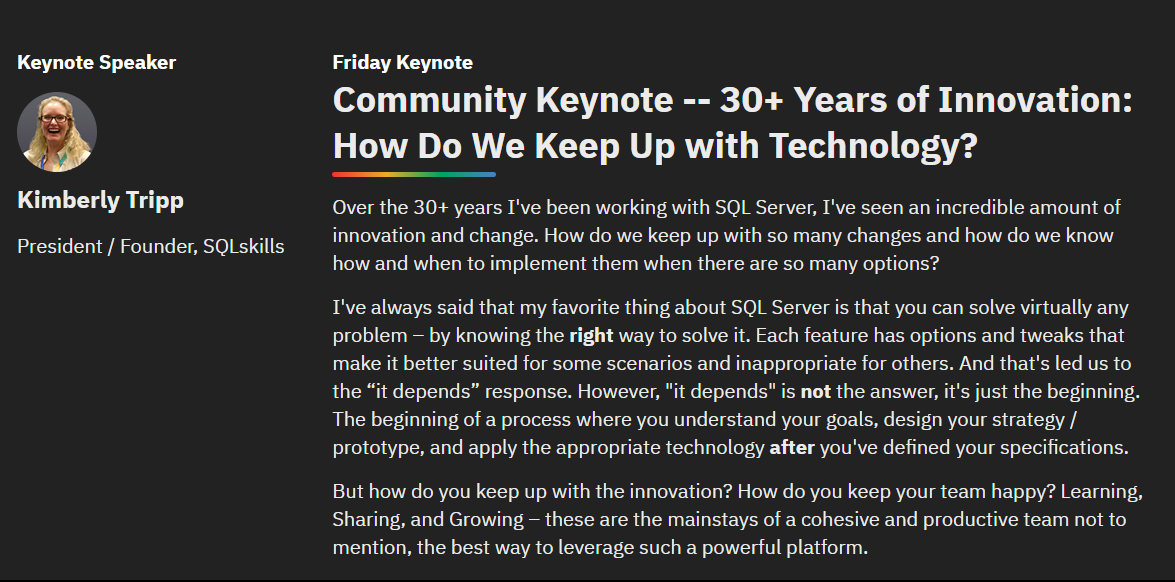
The keynotes as well look to be shaping up to be something special:

It will be much fun and excellent content this year. As always, happy to chat if you see me; this event is one I’ve attended, spoken at, and volunteered for since 2011. I look forward to seeing everyone there.

T-SQL Tuesday #135: The outstanding tools of the trade that make your job awesome

It’s been a while since I’ve posted on a T-SQL Tuesday topic and glad to see the topic being discussed by Mike Bronowski (blog) on tools.

Throughout my career, I’ve worked for companies that have allowed me to utilize some pretty nice tools. Whether they are vendor or community-related there are a plethora of options for all platforms and prices.

Some of the ones that I have a special place for can be found here, but I’ll specifically name a few below:

Forums

SSIS

Maintenance / Performance Tools

Utility Tools

Red Gate Tools

SQL Sentry Tools

PowerShell Tools

One thing outside of the above I like to look at periodically are mentors. These morph over time and have a unique ebb and flow about them based on where you are at in your life, career, or journey. Solidifying some good mentors can become just as valuable an asset as a physical tool in your toolbelt.

Thank you, Mike for hosting this month!

What is T-SQL Tuesday

If you want to learn the what, when, how or why to T-SQL Tuesday you can click here for more information.

T-SQL-Tuesday

Release Your Inner Synapse

I don’t know about you, but as Microsoft has produced the Azure Synapse platform, I see a plethora of needs that could be fulfilled by it. Being in a financial institution I am constantly reminded of the world we live in now and the real need and desired for all things data.

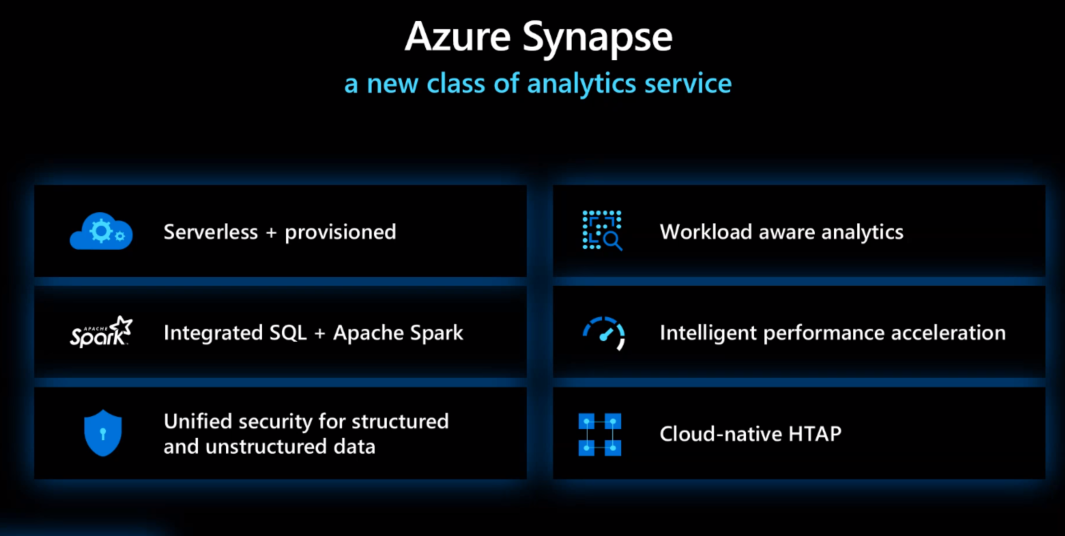
The Azure Synapse platform is a complete platform for analytics which blends data warehousing needs, data integration, and big data into one end to end single service at a cloud scale.

Now more than ever data is at the forefront of business. It is the lifeblood to most and as the digital economy continues to expand at an exponential rate technology will need to keep pace. “Without analytics, data is a cost center, not a resource” I think that statement provides great insight into the future of businesses and data itself. If you stop and think about it, data in general, will either make or break you in most cases from a business perspective, and we are only as good as the information we take in at any given time.

Below is a high overview of what the Analytics Service offers:

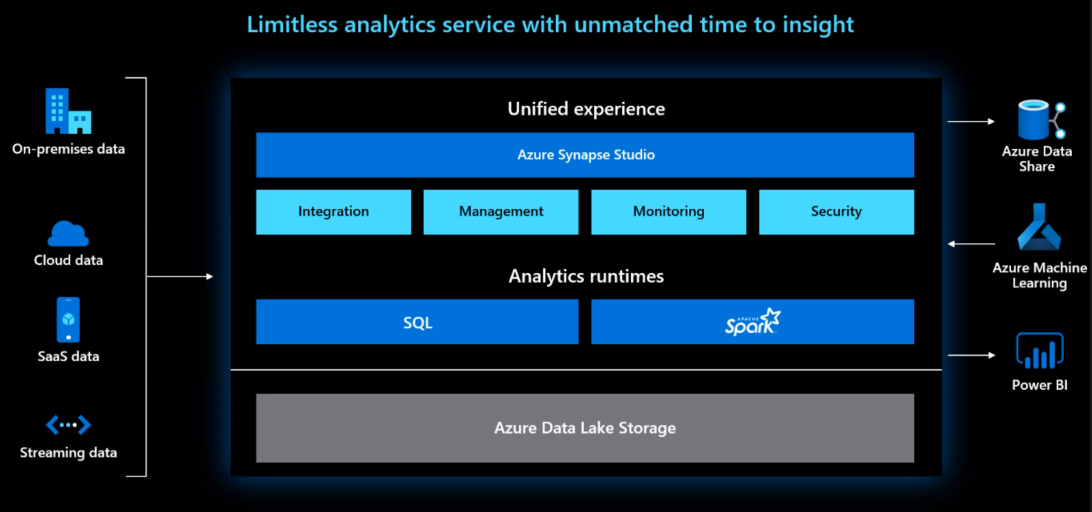
As companies start need data at an unprecedented pace we find that having a one-stop shop offering for your data will become a game changer and give companies an edge. What does this unified experience look like for you?

I have many opinions about the platform, but what I like a lot about it is the ability to support multiple programming languages such as Python, .NET, SQL, and others. This combined with having integrations in AI, Machine learning, and business intelligence all on the same unified platform continues to set the bar high for future enhancements.

As you can see from the above figure the Analytics runtimes for SQL and Spark. Being able to have insights into shared data lakes opens several doors for businesses to take advantage of analytics like never before.

Security is also a big proponent of Azure Synapse. From automated threat detection to always-on data encryption; to column-level security you will find that there is an elaborate methodology in keeping your data safe and secured. One thing I still would like to check out is the Dynamic Data Masking that Azure Synapse supports.

If you haven’t checked into Azure Synapse yet I encourage you to do so. As you get acclimated and dive into it you will find quickly that you are in control of your data allowing you to query your data on your terms.

Additional resources to help you get started are:

Azure Synapse Analytics

Azure Synapse Documentation

Get Started with Azure Synapse Analytics

Why I’m Running For The PASS Board – Again

Hello, it’s amazing to me how fast the past couple of years have gone by as I’ve served on the PASS Board. It has been a journey that has been both rewarding and challenging, but I would not change any of it. At times the challenges have been great, the stress large. Representing the PASS Community is something that shouldn’t be taken lightly.

I have given much thought to this, and I am writing today to say I will be running again for the Board of Directors At Large seat for PASS.

Now, often in a post like this you would expect to read about my accomplishments, my vision, and how I will make things better. I will keep this simple, clear, and concise:

  1. I’m running because I believe in the PASS Community and what it has done for me and my professional colleagues.
  2. My passion for helping others succeed has only grown since I decided to initially run almost two years ago.
  3. There is always room for improvement; a belief that has helped me grow in my career. I strive to be better than I was yesterday, and the same concept goes for me as a Board member.
  4. Some believe you can’t make a difference as a Board member, but in living and breathing the Board duties, I have witnessed many great things happening contrary to this notion.
  5. I view this as a WE thing; not a me thing. I was told it would be a challenge, whether that be with community members, working with the Board, or collaborating with PASS HQ. I’m happy to say this hasn’t been the case. We are a team and together we can and do accomplish so much. Doesn’t mean we will always agree; it does mean that tough decisions will be needed. To that I say, let’s go!
  6. While Board members can burn out over time and stop contributing, if you know me at all, then you will realize that hasn’t been the case with me. Listen, I’m not perfect and you will never hear me say that I am. What I can tell you is that I’ll continue to fight for this community and make it better than it was yesterday.

I hope many more people will run for the Board in the future. Yes it is hard work. But despite the rumor that one can’t make a difference – a true difference – they can. Let’s get after it. Believe in yourself and fuel up with optimism.

I appreciate you reading this and if you deem me worthy enough of a second run, I’m happy and willing to serve alongside some great individuals and professionals. It’s been an honor and privilege.

T-SQL Tuesday #119 – Changing Your Mind

This month Alex Yates (B|T) is hosting T-SQL Tuesday which is a monthly blog party started by Adam Machanic (B|T) and co-ordinated by Steve Jones (B|T)

The challenge that Alex has proposed this month regarding what have we, as data professionals, changed our mind about over time is a great one.

Starting out as a developer, becoming a database administrator, and morphing into management I have grown over time in certain areas. One of those areas is the specific need to understand all aspects of the various technical and business units. Particularly how they are intertwined with each other.

Let me explain. My mindset in the past had been fix what needed to be fixed, and on to the next innovative solution. If you didn’t take the solution provided then that’s okay; but expect the issues to persist. Having in depth knowledge of how the processes all flow together and what makes each business unit tick however is something that has helped over time.

I’ve learned that bridging gaps and bringing everyone together has helped immensely in trouble shooting issues, learning what business is trying to actually accomplish, and proving that developers, sysadmins, and DBAs can work together. Who knew right?

This type of mentality is ever challenging and always a moving target. One that will always require fine tuning. When it clicks though the fruitful gains are exponential. The key being to always try to figure out the “why”. Set emotion aside and work together reviewing the facts while partnering and collaborating as much as possible. I’m always enamored when teams who work for the same company struggle with this concept.

Thanks Alex for hosting this month and for what you do in the community. Cheers!


tsql2sday-300x300

180 – Is It Time For A Turnaround?

What needs to change? The challenge to explore is are there things in your current day to day that needs to change? Maybe there are some habits, things, processes that need to be turned around. One of the most difficult things about turning around in my mind is acknowledging the fact that you were actually going the wrong way. What….we make mistakes…..nope, never, nuh uh. Admitting to that is not often an easy task.

We may uncover some inefficiencies in your processes at work, we might discover that the direction we’ve been heading in leads to a dead end, or we may even get to that point where we say, “yeah it’s time for a turn around”. It’s then you begin to start to look for that exit ramp; you look for the place where you can turn your flicker (turn signal for some of you) on so you can get off the journey you are on and go a different route.

How do you turn around? Sometimes our pride makes it hard in admitting the road we have been on isn’t the right road we should be taking. We don’t like using the word humble because it makes you feel vulnerable or weak. In my past experiences in technology, and I’ve been doing this now for 18 years is that there is usually always something we (I) could have been doing better.

The path you are on may feel right and other people are taking it, and because it feels right it is unnatural to do a 180; a different direction than what others are doing – it’s not natural.

When is the last time you yourself have said the words I’m sorry? If you haven’t in a while then yeah it’s unnatural. C’mon you know what I’m talking about. You run into these people everywhere; the ones that think their way is always the right way. They call you stupid or point out your mistakes 24/7 telling you how ignorant you are. Or you run into someone who says you won’t be worth anything why are you even trying. Entertain me for a minute and what if that same person did a 180; they didn’t give you a heads up and came up to you and told you that they were sorry. It’s a different road.

This is all well and good Chris but what about you? Ha, well my friend I’ve been taken several exit ramps over the years to turn around. Both professionally and personally. This post is more on the technical side of the house so, there are some things that maybe we can do differently in our day to day work that may cause us a 180-degree turnaround.

  • Backup plans
  • Maintenance
  • Life Cycle Management
  • Documentation (sigh, yeah I need to look at this one)
  • Platform Upgrades
  • Communication (this could be a topic in and of itself and in my mind should be a continual work in progress)
  • Hiring guidelines
  • Career Pathing
  • The security model for databases
  • Disaster Recovery

The above is not an all-inclusive list but it’s a start. Some of the ways that have helped me over the years and may help you in tackling such an initiative are:

Think Progress, not perfection  – this is a big deal because if you are like me you’d like everything to be perfect. You may find yourself using the term “Never Again”. I challenge you to let go of that mentality and you claim victory one day at a time.  If you mess up one day; and you will. It will be okay. You can’t change yesterday, but today is a new beginning.

Think future, not past – yes the past is important because it is full of lessons learned. With that said the past can’t keep you chained; instead focus on the future of where you are going; where your team is going, and where your shop is going.

Think training, not trying – this may sound weird coming from me because I do believe you should try. That’s not what I’m talking about here. I’m focused on training yourself for the tasks at hand. Example; if I wanted to go try for the Olympics and I go out and try my chances of succeeding aren’t very high. Why? cause I haven’t trained for it. Then if I look at my day job at the shop if I am trying to do something without training for it am I being efficient enough?

So, I ask this question – is it time for a turnaround? I get to work with a lot of tech people locally, regionally, nationally, and globally. I hear a lot that this would have been nice to know a long time ago and it’s too late now. I’m too far in my career. You don’t want to take that exit ramp because of the unknown. My own personal opinion it’s never too late to make a turnaround.

Now I don’t know the road you’ve been on I can only speak for myself. All I am presenting here is that if you are at a point where you know there needs to be a turn around don’t be afraid to take it. Keep fighting the good fight and make a difference wherever you are.