Tag Archives: SQLServer

Why Data Silos Hurt Your Business Performance

Let’s be honest – data is the backbone of modern business success. It is the fuel that drives smart decisions, sharp strategies, and competitive edge. But there is a hidden problem quietly draining productivity: data silos.

What is the Big Deal with Data Silos?

Picture this – you have teams working hard, digging into reports, analyzing trends. But instead of sharing one centralized source of truth, each department has its own stash of data, tucked away in systems that do not talk to each other. Sound familiar? This disconnect kills efficiency, stifles collaboration, and makes decision-making way harder than it should be.

How Data Silos Wreck Productivity

Blurry Vision = Ineffective Decisions Leadership decisions based on incomplete data lead to assumptions rather than informed facts.

Wasted Time & Redundant Work
Imagine multiple teams unknowingly running the same analysis or recreating reports that already exist elsewhere. It is like solving a puzzle with missing pieces – frustrating and unnecessary.

Slower Processes = Missed Opportunities
When data is not easily accessible, workflows drag, response times lag, and the business loses agility. In fast-moving industries, those delays can mean lost revenue or stalled innovation.

Inconsistent Customer Data = Poor Experiences
When sales, marketing, business units, and support teams are not working off the same customer data, you get mixed messages, off-target campaigns, and frustrated customers.

Breaking Free from Data Silos

To break free from stagnation, proactive action is essential:

Integrate Systems – Invest in solutions that connect data across departments effortlessly.
Encourage Collaboration – Get teams talking, sharing insights, and working toward common goals.
Leverage Cloud-Based Platforms – Make real-time access to critical data a priority.
Standardize Data Practices – Guarantee accuracy and consistency with company-wide data policies.

Data silos are not obvious at first, but their impact is massive. Fixing them is not just about technology, it is about a smarter, more connected way of working. When businesses focus on integration and accessibility, they unlock real efficiency and stay ahead of the game.

Unlocking Real-Time Financial Insights: The Power of Microsoft Fabric

Microsoft Fabric is transforming real-time analytics for financial institutions. It provides a unified data platform. This platform integrates various data sources into a single, cohesive system. This integration breaks down data silos. It enhances decision-making and customer insights. Fabric’s real-time intelligence capabilities allow financial institutions to extract insights from data as it flows. This enables immediate decision-making. It supports critical functions like fraud detection, risk management, and market trend analysis.

With AI embedded throughout the Fabric stack, routine tasks are automated. Valuable insights are generated quickly. This boosts productivity and keeps organizations ahead of industry trends. Additionally, Fabric ensures data quality, compliance, and security. These elements are crucial for handling sensitive financial information. They also help in adhering to regulatory requirements. The architecture is scalable to support the needs of financial institutions. They are dealing with gigabytes or petabytes of data. It integrates data from various databases and cloud platforms. This creates a coherent data ecosystem.

Real-time analytics allow financial institutions to respond swiftly to market changes, making informed decisions that drive competitive advantage. By adopting Fabric, financial institutions can unlock new data-driven capabilities that drive innovation and keep a competitive edge.

Moreover, Microsoft Fabric’s ability to deliver real-time analytics is particularly beneficial for fraud detection and prevention. Financial institutions can track transactions as they occur, identifying suspicious activities and potential fraud in real-time. This proactive approach not only protects the institution but also enhances customer trust and satisfaction. The speed of real-time analytics allows immediate addressing of potential threats, reducing the risk of financial loss and reputational damage.

Besides fraud detection, real-time analytics powered by Fabric can significantly improve risk management. Financial institutions can continuously assess and manage risks by analyzing market trends, customer behavior, and other relevant data in real-time. This dynamic risk management approach allows institutions to make informed decisions quickly, mitigating potential risks before they escalate. The ability to respond to changing market conditions is a critical advantage. Addressing emerging risks in real-time is vital in the highly volatile financial sector.

Furthermore, the integration of AI within Microsoft Fabric enhances the predictive analytics capabilities of financial institutions. By leveraging machine learning algorithms, institutions can forecast market trends, customer needs, and potential risks with greater accuracy. This foresight enables financial institutions to develop more effective strategies, improve their operations, and deliver personalized services to their customers. The predictive power of AI is significant. It, joined with real-time data processing, helps financial institutions stay ahead of the competition. They also meet the evolving demands of the market.

Microsoft Fabric’s technical architecture is designed to support complex data operations seamlessly. The integration structures like Data Engineering, Data Factory, Data Science, Real-Time Intelligence, Data Warehouse, and Databases into a cohesive stack. OneLake, Fabric’s unified data lake, centralizes data storage and simplifies data management and access. This integration eliminates the need for manual data handling, allowing financial institutions to focus on deriving insights from their data.

Fabric also leverages Azure AI Foundry for advanced AI capabilities. It utilizes machine learning efficiently. This enables financial institutions to build and deploy AI models seamlessly. This enhances their predictive analytics and decision-making processes. The AI-driven features, like Copilot support, offer intelligent suggestions and automate tasks, further boosting productivity. Additionally, Fabric’s robust data governance framework, powered by Purview, ensures compliance with regulatory standards. It centralizes data discovery and administration. It governs by automatically applying permissions and inheriting data sensitivity labels across all items in the suite. This seamless integration ensures data integrity and transparency, essential for building trust with customers and regulators.

Lastly, Fabric’s scalability is a key technical advantage. It supports on-demand resizing, managed private endpoints, and integration with ARM APIs and Terraform. This ensures that financial institutions can scale their operations efficiently. They can adapt to changing business requirements without compromising performance or security.

Long-term, Fabric will play a crucial role in the future of data analytics. It offers a unified platform that seamlessly integrates various data sources, enabling more efficient and insightful analysis. It handles large-scale data with high performance and reliability. This ability makes it indispensable for driving innovation. It also supports informed decision-making in the analytics landscape.

AI Innovation in Microsoft Keynote

I’m thrilled to be covering the Microsoft Keynote: Fuel AI Innovation with Azure Databases on Day 1 of the PASS Data Community Summit. Data is the driving force behind innovation, powering the development of transformative AI applications. In this keynote, join Shireesh and the Microsoft engineering team as they delve into harnessing the power of data across the Azure databases portfolio to drive groundbreaking advancements. Embark on a journey with vector search, multi-agent apps, and more, and discover how to unlock new patterns like retrieval augmented generation (RAG). Explore the latest database innovations in SQL Server, Azure SQL, Azure Cosmos DB, Azure Database for PostgreSQL, and Azure Database for MySQL that enhance operational efficiency, deliver personalized user experiences, and revolutionize our interaction with technology.

Be sure to check back for live blogging updates throughout the keynote to stay informed on all the latest developments!

Live Updates:

Over 1700 attendees from 46 countries are in attendance this week.

5 topic tracks

200+ sessions and speakers.

45% first timers

Steve Jones did a great welcome and initial overview of the conference, stats, and talking about the pressures of work and how we deal with those pressures. Continuous learning about what people go through and how it interacts with data.

53% say upskilling is their biggest challenge.

A huge welcome to the scholars. Multiple scholarship programs with a round of applause from the audience.

November 17th, 2025 will be the next date for the PASS Data Summit here at the same location.

Shireesh Thota takes the stage next……

Fuel AI innovation with Azure Databases – a data compass that you can trust.

Shireesh honoring the tradition of PASS Data Summit back from early 2000 through each decade.

135+ user groups and 126,000 members of Azure Groups worldwide.

SSMS 21 and Copilot in SSMS is here!!!!!!

Bring cloud manageability to SQL Server anywhere….manage, govern, and protect your SQL Server from Azure.

Preview – Migration Assessment from SQL Server enabled by Azure Arc.

General Available – bi-directional disaster recovery with link feature in Azure SQL managed Instance.

In Preview is the next gen general purpose on Azure SQL managed Instance. 32 TB of storage, 500 dbs, lower storage latency, improved storage performance, and customizable I/O performance.

Build modern, AI-ready applications on cloud-scale databases – Azure SQL Database, Azure Cosmos DB, Azure Database for Postgres.

Preview – Native vector type and functions in Azure SQL Database

Coming soon – Vector Index with DiskANN

Announcing – Azure SQL Database Hyperscale enhancements – Storage up to 128 TB

Generally Available – Serverless auto-pause delay to 15 minutes.

Preview – Vector indexing and search in Azure Cosmos dB for NoSQL

Generally Available – flat and quantized flat vector indeed in Azure Cosmos dB for NoSQL,

Preview – DiskANN indexing in Azure Database for PostgreSQL

General Available – PostgreSQL Azure AI Extension

Preview – PostgreSQL In-Database embedding generation

Preiview – Mirroring in Fabric for Azure SQL Database and Azure Cosmos DB

How Redgate’s Test Data Manager Can Enhance Automated Testing

A brief overview of the benefits and challenges of automated testing and how Redgate’s Test Data Manager can help.


Automated testing uses software tools to execute predefined tests on a software application, system, or platform. Automated testing can help developers and testers verify their products’ functionality, performance, security, and usability and identify and fix bugs faster and more efficiently. Automated testing can reduce manual testing costs and time, improve software quality and reliability, and enable continuous integration and delivery.

However, automated testing is not a silver bullet that can solve all software development problems. Automated testing also has some limitations and challenges, such as:

  • It requires a significant upfront investment in developing, maintaining, and updating the test scripts and tools.
  • It cannot replace human judgment and creativity in finding and exploring complex or unexpected scenarios.
  • It may not cover all the possible test and edge cases, especially for dynamic and interactive applications.
  • It may generate false positives or negatives, depending on the quality and accuracy of the test scripts and tools.

One of the critical challenges of automated testing is to ensure that the test data used for the test scripts are realistic, relevant, and reliable. Test data are the inputs and outputs of the test scripts, and they can significantly impact the outcome and validity of the test results. Test data can be sourced from various sources, such as production, synthetic, or test data generators. However, each source has advantages and disadvantages, and none can guarantee the optimal quality and quantity of test data for every test scenario.

That’s why Redgate Test Data Manager from Redgate is a valuable tool for automated testing. Test Data Manager is a software solution that helps developers and testers create, manage, and provision test data for automated testing. Test Data Manager can help to:

  • Create realistic and relevant test data based on the application’s data model and business rules.
  • Manage and update test data across different environments and platforms.
  • Provision test data on demand, in the proper format and size, for the test scripts.
  • Protect sensitive and confidential data by masking or anonymizing them.
  • Optimize test data usage and storage by deleting or archiving obsolete or redundant data.

By using TDM, developers and testers can enhance the quality and efficiency of automated testing, as well as the security and compliance of test data. TDM can help reduce the risk of test failures, errors, and delays and increase confidence and trust in the test results. TDM can also help save time and money by reducing the dependency on manual processes and interventions and maximizing the reuse and value of test data.

Automated testing is an essential and beneficial practice for software development, but it has some challenges and limitations. Test data management is one of the critical factors that can influence the success and effectiveness of automated testing. Using a tool like TDM from Redgate, developers and testers can create, manage, and provision test data for automated testing more efficiently, reliably, and securely.

The Power of User Groups

AzureDataCommunity

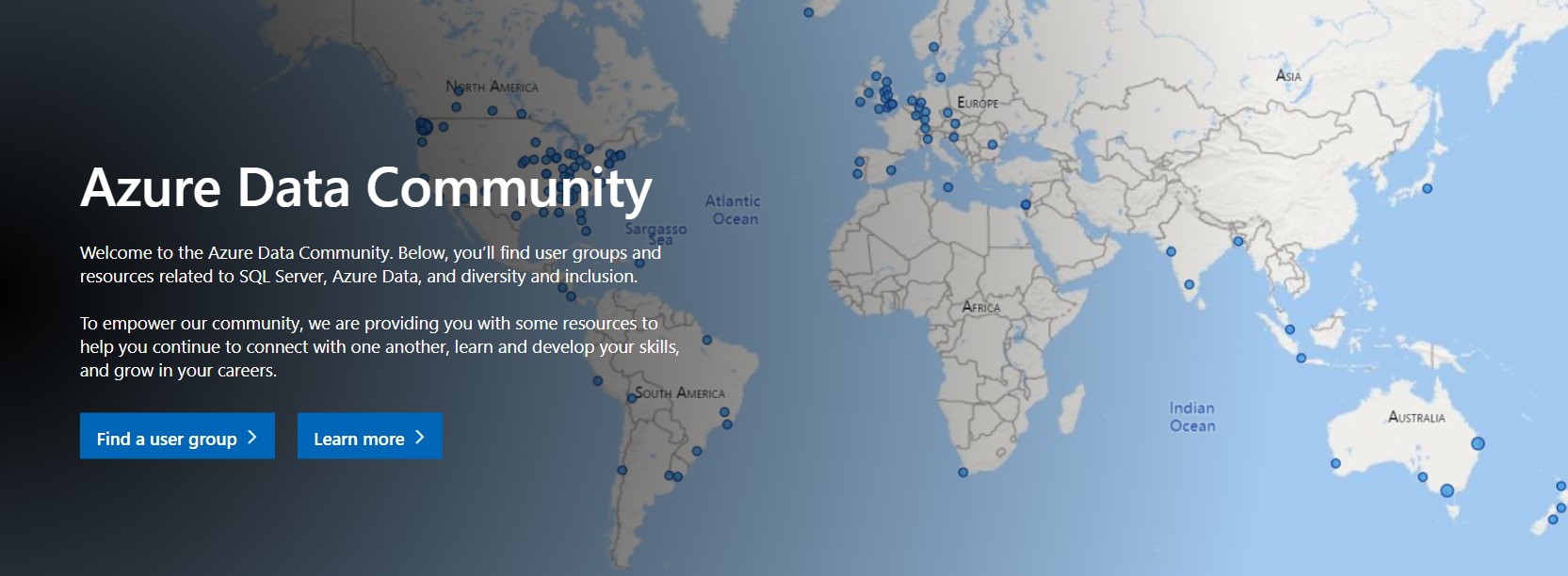
Fascination has always been with me when thinking of developing local talent. It has helped me immensely in my career both as an attendee, presenter, chapter leader, and more. One can glean immense value from becoming involved in a local UG (user group), whether by the connections made in networking, friendships formed, or learning something new that can help you on your journey.

This post isn’t one to talk about the past and looking at the rearview mirror, but seeing something tremendous and looking through the windshield. That phrase was told to me recently by a mentor, and it stuck with me. For those that aren’t aware, Microsoft has done a great job at intertwining a global network for user groups to come together and share knowledge to further impact communities.

Helpful Links:

  1. Can submit your group here – https://t.co/IzONhUQqel?amp=1
  2. Can submit your event here – https://t.co/0cE0sA5rbF?amp=1
  3. Find a user group on meetup – https://t.co/uRBu6utV5N?amp=1
  4. Upcoming community event list – https://t.co/IzONhUQqel?amp=1
  5. FAQ’s for the Azure Data Community – Azure Data Community FAQs – Microsoft Tech Community

This statement provides an in depth belief of what is starting to transcend community events globally in this arena:

We are Community Owned, Microsoft Empowered. Group leaders own their group, membership lists, content, etc. In that way we aren’t a governing umbrella organization. We’re a network of user groups with a common goal.

The Azure Data Community will continue to grow worldwide, and I challenge you to become involved in your local area. I’ve been fortunate enough to be in leadership at a local level and a global level in years past; nothing is more rewarding to see and help others continue to grow on their journey.

T-SQL Tuesday #135: The outstanding tools of the trade that make your job awesome

It’s been a while since I’ve posted on a T-SQL Tuesday topic and glad to see the topic being discussed by Mike Bronowski (blog) on tools.

Throughout my career, I’ve worked for companies that have allowed me to utilize some pretty nice tools. Whether they are vendor or community-related there are a plethora of options for all platforms and prices.

Some of the ones that I have a special place for can be found here, but I’ll specifically name a few below:

Forums

SSIS

Maintenance / Performance Tools

Utility Tools

Red Gate Tools

SQL Sentry Tools

PowerShell Tools

One thing outside of the above I like to look at periodically are mentors. These morph over time and have a unique ebb and flow about them based on where you are at in your life, career, or journey. Solidifying some good mentors can become just as valuable an asset as a physical tool in your toolbelt.

Thank you, Mike for hosting this month!

What is T-SQL Tuesday

If you want to learn the what, when, how or why to T-SQL Tuesday you can click here for more information.

T-SQL-Tuesday

SQL Doc by RedGate

SQL DocI recently was on a call where a technical unit indicated they did not receive any form of documentation around the vendor database that was created. Now, seeing that I fall into the database profession it sparked my fancy. I began to ask a few questions to the individual who was asking for this documentation; these are important questions in that you have to determine if there is a need for what was running through my mind. Sure enough, the technical team, was just needing some guidance on overall structure and what they were dealing with in terms of tables, procedures, and so on. This group was trying to review and write a process around information they were not privy to.

My mind went straight for the SQL Doc utility that RedGate has available. It’s a simple utility really to utilize and often times can save the day for such cases like the one above. Check out the steps below on how easy the utility allows you to document a database on the fly:

Step 1: As you open the application you will be prompted to enter a server location followed by how you’d like to connect to it (Windows or SQL authentication). In this case we’ll just hook up to a local instance I have on hand.

image

Step 2: Once connected you’ll have some default settings. There will be a cover page option along with the databases that you want to document.

image

Step 3: Looking at the project you’ll begin to review some of the following information:

  • Database Selection
  • Server Properties
  • Server Settings
  • Advanced Server Settings
  • Sections that are included in the report

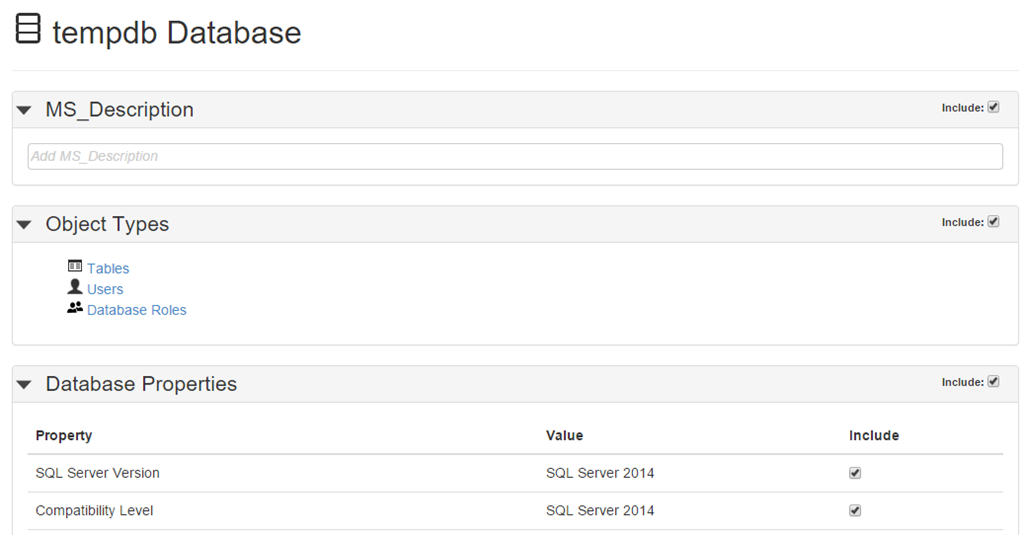
For this specific test I’m just going to take a look at the TempDB

image

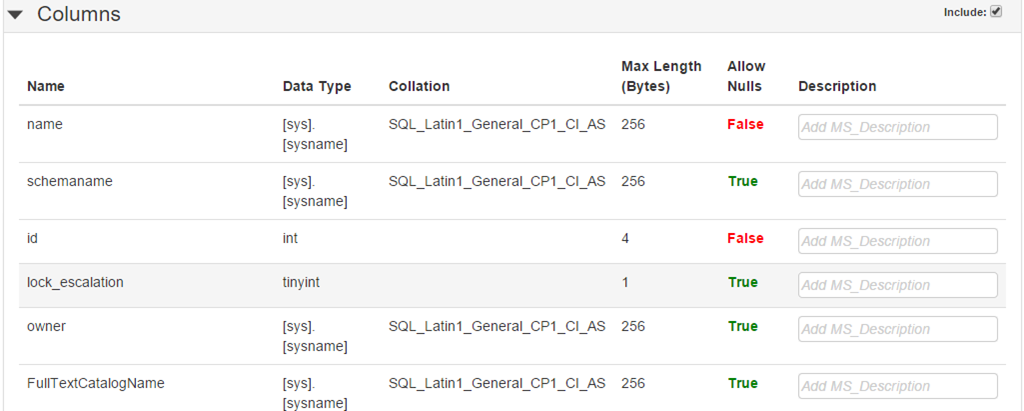
The screen capture will note that under Object Types you are able to drill into and get as granular as you can. The below example will show you a snippet from a table in the TempDB and will also show that you can enter a description of what the field is utilized for in the far right hand column under Description.

image

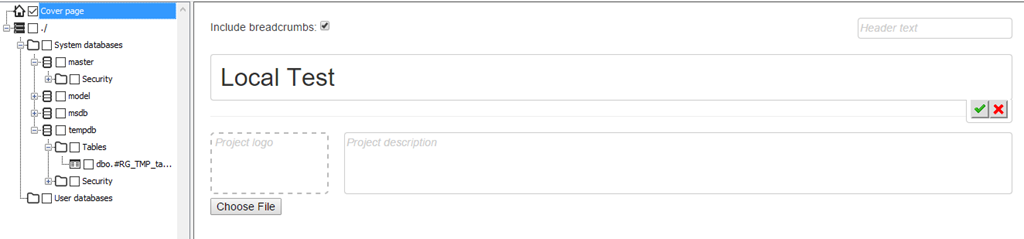
Step 4: If you have to save this documentation out for any meetings or other purposes you can create a cover letter along with any logo information and description. Simply click on the cover page option on the left menu and complete the following:

image

Step 5: After all the choices are made you can click on the General Documentation Go button on the menu and be prompted for the following:

image

image

Give the location and file a name and BOOM; you’re done.

Summary

You may find yourself in a situation where you are needing a quick hit for documentation purposes. If you are an avid RedGate user and enjoy using their SQL Doc product; or maybe you had this product and didn’t even know what it was then you can benefit greatly from documenting multiple databases in a matter of minutes. This post is to show you what type of utility SQL Doc is and what it can actually be used for in a real life circumstance. In the end it was the right product and right time to use it for a technical team in need. Well done RedGate, well done.

PASS Summit Live Keynote – Release 1

pass_2016_website

Joseph Sirosh taking the stage by first telling us a story with over 400 million children in India. Only 50% of them attend school regularly. Consider the loss of potential that could have been a doctor.

Millions more like these children; a world of lost human potential. Millions who drop out on opportunities. Enter the term Data. The school infrastructure and other parameters will allow them to predict school drop out and the risk of under performance.

All this from data? Over 5 million children will be scored by data machine learning and the Azure cloud?

A.C.I.D. Intelligence – Algorithms/Cloud IOT/Data

Intelligence of software in every piece of software that we have. Finished applications like office 365 to many more by sprinkling the so cold pixie dust of A.C.I.D into the mix.

Intelligence DB – Intelligent Lake – Deep Intelligence

Intelligence DB – pushing intelligence to where data lives. Sharing machine learning around marketable applications is key. This pattern will allow intelligence to become just like data.

SQL 2016 is truly becoming the platform for data intelligence


Is ROI for Vendors Worth the SQL Saturday Investment?

networkingPiggy backing onto the recent SQL Saturday post here in Louisville, I wanted to take a more in-depth look, from my perspective, on how vendors all fit into these events.

Having the opportunity to work alongside these vendors has been both a learning experience for myself along with forming new bonds along the way. Louisville has been fortunate enough to have some of the best vendors in our industry who see the importance of investing time in others for a few reasons.

  • Networking
  • Getting their products name out
  • Growing their local community pool
  • Bringing exposure to their company

SQL Saturday events provide a much more intimate setting with a lower number of attendees. Example our event for the past two years had over 220 users sign up. This is a much smaller scale then say what a PASS conference has signed up where over five thousand of your closest friends attend.

The SQL Saturday events allow the attendees to get up close and personal with the vendors on products that they may or may not use. That’s great Chris, but I’m a vendor and how would I get ROI out of it; because at the end of the day if I want to sponsor an event there needs to be some gains on my end?

This therein is a valid question and one that is not taken lightly. In speaking with a vendor they had this to say about our event:

Our sponsorship of SQL Saturday allowed us to connect with a wealth of developers and DBAs, in a single day. The event was organized, productive, and time well spent furthering our business in Louisville.

I am starting to see soft metrics, such as intangibles, in determining the business value sending data professionals for respective vendors to such events. What kind of intangibles? They’re the stuff that doesn’t show up in traditional cost-accounting methods but that truly makes a difference in maximizing the potential knowledge growth of the organization. These include employee learning, vendor interaction, business relationships, and networking. Some of these are clearly more quantifiable than others, but all are important to a vendors success.

Some outside thoughts on how ROI for vendors is applicable:

  • You have to evaluate your audience.
  • Make sure your input channel, in this case your interaction with attendees, has some new features for viewing.
  • List of attendees for potential future clients.
  • Make your presence known prior to event (outside the marketing done by said event).
  • Commitment from potential attendees
  • Flexibility

End of the day, vendors are a huge part from all angles in regards to SQL Saturday events. Getting a great local base at events like this continues to build and solidify companies advancement in the technology space; specifically around the Microsoft stack.

Conclusion

If you are interested in getting involved you can check out or view upcoming schedules at the SQL Saturday home page here.

From personal experience I know that talking with vendors at said events it has opened doors and opportunities for business in my current and previous shops along with building a network base for future discussions.

Are SQL Saturday’s Worth It?

VenueThis past weekend I was fortunate enough to be a part of Louisville’s (for those local the ‘ville) SQL Saturday event held at Indiana Wesleyan. Most of you who end up on this site are probably familiar with it, but for those that aren’t familiar with SQL Saturday events you can check out their site here.

Now to put on an event like this is nothing short of an incredible effort from volunteers, sponsors, speakers, and attendees. Being able to help co-organize the one here in Louisville has been a humbling yet gratifying experience. Let me see if I can break it down a different way for you, the reader, who may not have had the opportunity yet to volunteer or attend such an event.

Volunteers

You can see these people usually with matching shirts on and a lanyard with their name and a ribbon that only says “volunteer.” In the past when I’ve attended such events I knew people helped out to put something like this on, but never in my wildest dreams did I envision all that it took until I volunteered.

Volunteering is not for glitz, glamor, or glory. Instead volunteering is what helps the cogs in the wheel move to get the steam engine running down the track. It is the staple of helping afford the opportunity for free learning to attendees and colleagues in our field.

Many, many, and many hours go into planning and organizing an event; if you attend one of these events make sure you seek a volunteer or organizer out and say thank you for their time; they are doing this for free and on their own time away from their families.

Mala Mahadevan (B|T) as a founding organizer of our event I thank you for allowing me to be a part of it these past few years.

Sponsors

Over the years, SQL Saturday Louisville has been blessed with some great sponsors. For the previous two years, John Morehouse (B|T) and I have taken great pride in working with some stellar companies. Without them, we would not be able to do what we do which is concentrate on the attendees and helping people learn.

Our Gold sponsors this year were:

Gold

  1. EMC
  2. Farm Credit Mid-America
  3. Imperva
  4. Microsoft
  5. Republic Bank
  6. Pyramid Analytics


Our Silver and Bronze sponsors this year were:

SilverBronze

  1. Idera
  2. PASS
  3. PureStorage
  4. Tek Systems
  5. Click-IT Staffing
  6. Homecare Homebase
  7. Datavail
  8. SQLSentry

A major thank you for all of their contributions and it is always a pleasure to work with all of you.

Speakers

It always amazes me at the number of speakers we have who send in sessions to our event. These speakers are people from all over the U.S. who are willing to travel and give their time so attendees can learn. Getting to spend time with each of them is not always an easy task, but always thankful to catch up with many friends at the speaker dinner.

It was awesome to see the attendees interacting with the speakers asking their questions and getting insight into the variously presented topics. And, because of so many good sessions to choose from, there was a buzz in the air.

As is the case with the volunteers mentioned above, speakers also travel on their own dime, away from their families – a simple thank you goes a long way. Also, for these sessions, I do want to point out that feedback cards are provided; please please please take a moment and make sure you provide good insightful feedback to the speakers. Each speaker uses this feedback to improve their sessions or have take-a-ways on what may or may not have worked. Yes, folks, these are important!

I won’t list every speaker we had; that is not the intent of this topic. But I will take a moment and say to each and every speaker who attended SQL Saturday Louisville 531 we thank you.

Attendees

Two words – – THE PEOPLE. As I have stated, these last two years has been nothing short of amazing. Seeing light bulbs go off with attendees who are learning from some of the best, and having discussions with attendees is why we do what we do.

When individuals come to us stating it was their first time at the event, and they had no idea that there is a local Louisville SQL User Group opens the doors to help reach people in our tech community.

Steve Jones (B|T), who is part of my Fab Five, talks about Dreaming of SQL Saturday. If you have not had a chance to read his post, check it out. Attendees travel from quite a distance. Which tells me the people are eager to learn.

Conclusion

So, the question I opened with “Is SQL Saturday Worth It?” Considering what I know now versus what I knew then the answer is yes. Personally, being a product of these types of events, I am living proof of what can grow from the SQL Community.

Whether you volunteer, speak, sponsor, or attend, all of these make the wheel turn. It’s a team effort with a lot of hard work. So, next time you attend one of these events, please don’t take them for granted.

Here is to continued learning, as we move forward to grow this community!